Community • June 2,2026
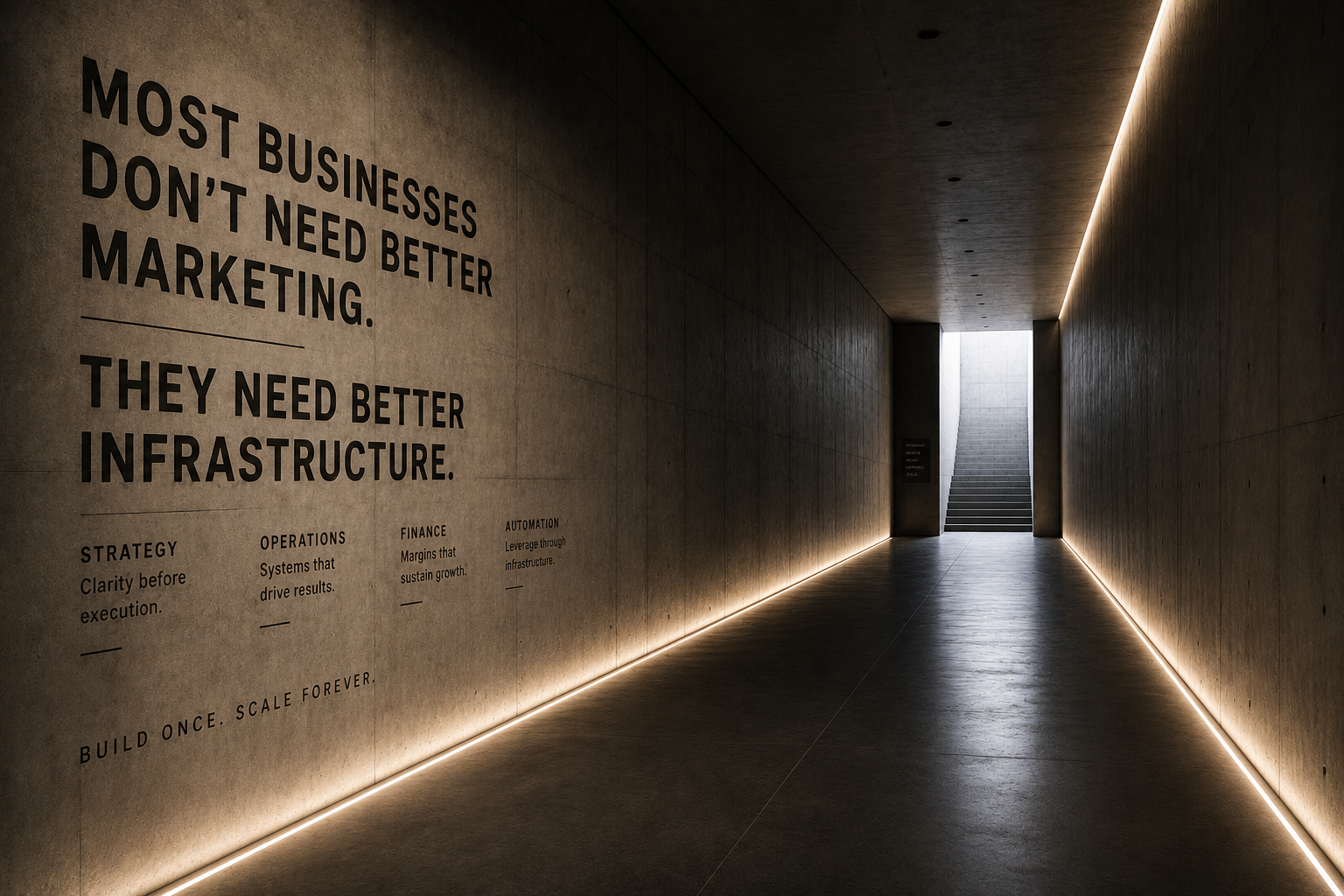
Most Businesses Need Better Infrastructure, Not Marketing
Most businesses believe they need more marketing when growth slows down. In reality, growth often exposes deeper operational weaknesses that were already there. As businesses scale faster than ever in 2026, infrastructure, systems, and execution are becoming far more valuable than attention alone.
Why Modern Growth Is Exposing Weak Businesses Faster Than Ever
One of the biggest misconceptions in business right now is the belief that every growth problem is a marketing problem.
When revenue slows down or growth plateaus, most companies immediately assume they need:
- more ads
- better SEO
- more social media content
- a website redesign
- more leads
- another marketing agency
And while marketing absolutely matters, it is often not the real issue limiting growth.
In many cases, marketing is simply exposing deeper operational weaknesses that already existed beneath the surface. More visibility does not automatically create a stronger business. In fact, rapid growth often magnifies inefficiencies faster than leadership can react to them.
This is why so many businesses in 2026 feel overwhelmed even while generating more attention online than ever before.
Growth is becoming easier to create.
But sustainable growth is becoming significantly harder to manage.

Modern Businesses Are Scaling Faster Than Their Systems
Technology dramatically accelerated business growth over the past several years. AI tools, paid advertising, social media, automation platforms, and digital distribution now allow businesses to generate visibility at a speed that was almost impossible a decade ago.
A company can go viral overnight. A founder can build an audience within months. Businesses can suddenly generate hundreds of leads through paid media, short-form content, referrals, or creator partnerships very quickly.
But growth creates pressure.
When demand increases rapidly, weak systems become exposed immediately. Businesses that once operated comfortably at a smaller scale suddenly experience:
- operational bottlenecks
- inconsistent communication
- poor client onboarding
- leadership overload
- delayed execution
- team confusion
- declining client experience
This is one of the biggest reasons businesses plateau after initial growth.
The infrastructure behind the business often cannot support the momentum being created.
Marketing Is Often Exposing Problems — Not Solving Them
A lot of businesses believe more leads will automatically solve their growth issues.
But in reality, more leads often amplify existing operational problems.
If a company already struggles with:
- organization
- fulfillment
- communication
- delegation
- internal systems
then increasing demand usually creates more chaos instead of more stability.
This is why some businesses experience operational breakdowns immediately after growth starts accelerating. Leadership becomes reactive, employees become overwhelmed, and execution quality begins declining because the business itself was never structurally prepared for scale.
Marketing did not create the problem.
Marketing simply exposed it faster.
That distinction is extremely important.
Most Businesses Are Operating Reactively
One of the clearest signs a business lacks proper infrastructure is constant reactivity.
The company is always:
- rushing
- improvising
- fixing mistakes
- responding emotionally
- changing priorities constantly
- operating without clear systems
Every week feels urgent because the business lacks operational stability underneath the surface.
This becomes increasingly dangerous as companies grow because complexity compounds rapidly. More employees, more clients, more communication channels, and more operational responsibilities all increase pressure on leadership.
Without scalable systems, businesses eventually reach operational ceilings where growth itself becomes exhausting.
The company may continue generating revenue, but internally everything begins feeling fragile.
The Businesses Winning Right Now Are Operationally Aligned
One of the biggest shifts happening in modern business is that operational excellence is becoming a major competitive advantage.
Almost every company now has access to:
- AI tools
- paid advertising
- social media
- automation software
- content creation platforms
Marketing advantages are becoming increasingly commoditized.
What separates businesses long-term is execution.
The companies scaling effectively in 2026 are usually operating with:
- clear communication
- strong delegation
- repeatable systems
- operational visibility
- leadership alignment
- scalable workflows
That structure creates consistency internally and externally.
Clients can feel when a business is organized. Communication feels smoother, onboarding feels intentional, expectations feel clearer, and execution feels more stable. Strong infrastructure creates confidence, and confidence creates trust.
Businesses Are Underestimating Operational Debt
A lot of businesses accumulate what could be called:
operational debt.
Operational debt happens when companies grow without improving their internal structure. Shortcuts begin stacking on top of each other:
- undocumented processes
- inconsistent workflows
- unclear responsibilities
- poor reporting systems
- reactive communication
- dependency on founders
At first, these issues seem manageable because the business is still relatively small.
But over time, operational debt compounds just like financial debt.
Eventually:
- teams become dependent on leadership
- execution slows down
- communication breaks down
- decision-making becomes reactive
- scaling becomes exhausting
This is one of the biggest reasons founders feel trapped inside businesses they originally built for freedom.
The company grows, but operational maturity does not grow with it.
Businesses Need Systems That Scale
The systems that help a company reach one stage of growth often cannot support the next stage.
A founder manually managing everything may work initially, but eventually that model becomes unsustainable. Businesses reaching higher levels of growth require:
- delegation systems
- operational SOPs
- reporting frameworks
- automation
- accountability structures
- communication systems
- scalable workflows
Without these systems, growth starts creating friction instead of momentum.
This is why many businesses feel operationally heavier as they grow larger. Complexity increases faster than structure, and leadership eventually becomes the bottleneck for the entire company.
Scalable businesses remove dependency from individual people and build systems capable of supporting long-term execution consistently.
Modern Businesses Need More Than Marketing Agencies
One of the biggest changes happening right now is that businesses increasingly want strategic operators instead of isolated service providers.
Traditional marketing agencies typically focus only on visibility:
- ads
- content
- SEO
- branding
- social media
But modern businesses often need much more than traffic generation alone.
They need:
- operational structure
- growth systems
- process optimization
- leadership support
- automation
- infrastructure
- strategic execution
This is why the consulting landscape is evolving rapidly.
Businesses no longer just want ideas. They want implementation, operational clarity, and scalable systems that support sustainable growth long-term.
Execution is becoming significantly more valuable than pure strategy alone.
Growth Without Infrastructure Creates Burnout
One of the most overlooked realities of entrepreneurship is that growth itself can become destructive without operational structure.
Founders often chase:
- more revenue
- more clients
- more visibility
- more expansion
without realizing the infrastructure underneath the business is slowly collapsing under pressure.
This creates:
- burnout
- leadership fatigue
- operational chaos
- declining client experience
- inconsistent execution
- emotional exhaustion
The business may look successful externally while internally feeling increasingly unstable.
This is why strong infrastructure is not just about efficiency.
It is about sustainability.
Businesses built on strong operational foundations scale with significantly less chaos, less emotional volatility, and stronger long-term stability.
Final Thoughts
Most businesses do not fail because they lack ambition, creativity, or marketing.
They fail because growth eventually exposes operational weaknesses the company never solved early enough.
Marketing still matters tremendously. Visibility, positioning, audience growth, and brand awareness all remain critical in modern business. But marketing alone cannot compensate for weak infrastructure forever.
The businesses winning in 2026 are not simply generating more attention.
They are building:
- stronger systems
- stronger operations
- stronger leadership
- stronger execution
- stronger infrastructure
Because long-term growth is not just about attracting momentum.
It is about building a business capable of sustaining it.
Summary: Growth doesn't break businesses. Weak systems do. Discover why operational infrastructure, execution, and scalability are becoming the true competitive advantages behind modern business growth.
Ready to build a brand that will stand out?
We help businesses grow with strategy, systems, and marketing that actually works.
Work With Us >Our Top Blogs

Community • June 2,2026
Most Businesses Need Better Infrastructure, Not Marketing
Community • June 2,2026
Why Community Is Beating Content in 2026
The Operator's Journal
Stay ahead with BCG insights on innovation strategy and delivery
Related Insights
Lets Build What's Next
For Businesses looking for clairty, structure, and scalable growth
Insights
Work
Capabilities
About
Contact
Social Media
Chrisbryan@thechrisbryan.com