
Mapping the 9 Touchpoints a Patient Hits Before They Ever Call Your Office
Ask most practice owners where their patient journey starts, and they'll say "the consult" or maybe "when they fill out the contact form." That's not where it starts. That's close to where it ends.
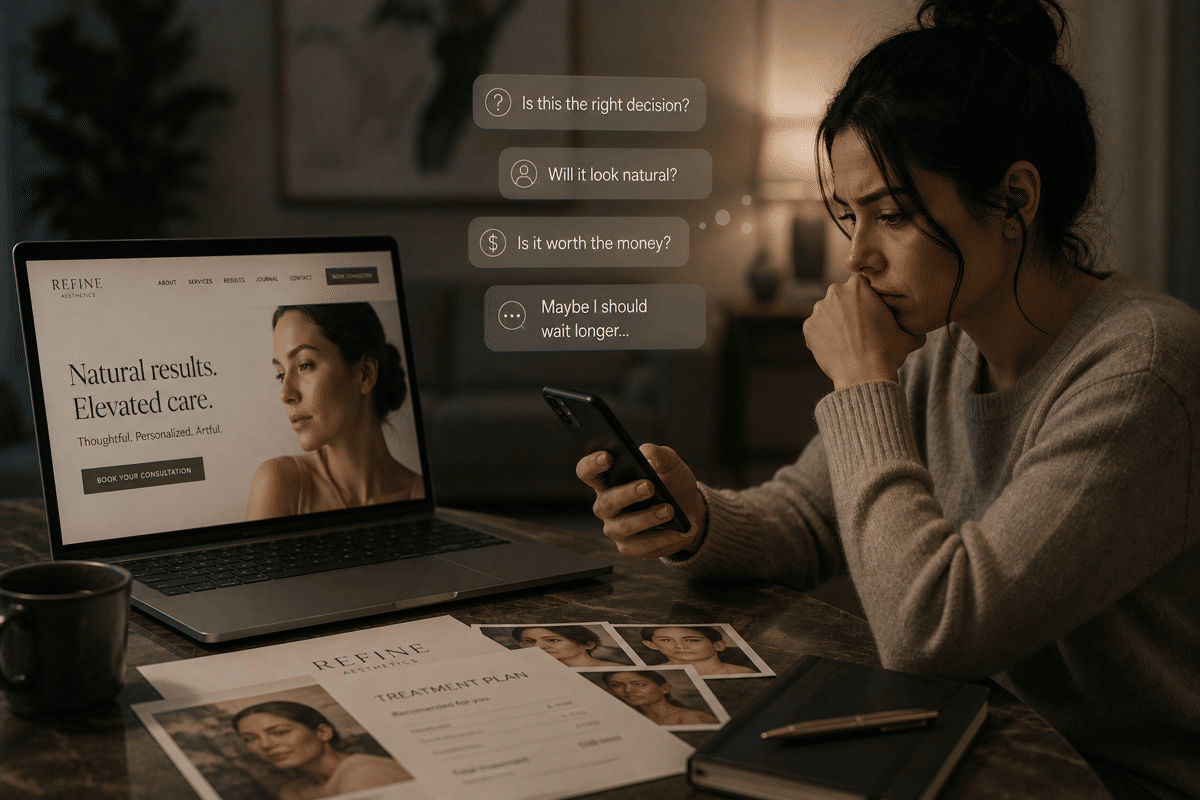
By the time a prospective patient submits an inquiry, they've usually already been through a string of touchpoints your practice barely controls and almost never audits. Each one is a small trust checkpoint. Pass enough of them and the patient reaches out. Fail one at the wrong moment and they quietly close the tab and never tell you why.
Most practices have never actually walked this path the way a real patient walks it. They've seen their own website through the eyes of someone who already knows the practice inside and out. They've never opened an incognito browser, searched the way a stranger searches, and followed the same path a nervous, skeptical, comparison-shopping patient follows before they trust you enough to call.
Here's what that path usually looks like, touchpoint by touchpoint.
1. The Search Result
This is touchpoint zero. Before a patient sees anything you've built, they see how you show up in a Google search — your business name, your review count, your star rating, maybe a handful of photos Google pulled on its own. If your review count looks thin compared to the practice listed above you, or your star rating has slipped below 4.5, some percentage of patients never click through at all. You lose them before they've seen a single thing you actually built.
This touchpoint is also where the comparison starts, even though the patient hasn't clicked anything yet. A search for "med spa near me" or "board certified plastic surgeon [city]" returns a map pack with three or four practices stacked directly against each other — same layout, same format, easy to scan in seconds. The patient isn't reading anything at this stage. They're pattern-matching: which of these four practices has the most reviews, the highest rating, the most recent activity. If you're the practice with 340 reviews at 4.9 stars next to a competitor with 40 reviews at 4.6, you've won the first impression before either practice has said a word. If it's reversed, you're already playing catch-up on every touchpoint that follows.
It's also worth knowing that this touchpoint isn't static — it's the one most within your control that most practices never actively manage. Review count and rating aren't fixed facts about your practice, they're a number you can move month over month with a basic ask-for-a-review process. Most practices leave this to chance, which means they're leaving the very first impression a patient forms to chance too.

2. The Website Homepage
This is the first real impression, and it happens fast — most visitors decide whether to keep exploring or leave within the first several seconds. They're not reading your mission statement. They're making a snap judgment based on visual polish: does this look like a $3M practice or a practice that hasn't touched its site since 2019. Load time matters here too. A slow homepage doesn't just annoy people, it reads as a signal that the business behind it isn't running tight.
What patients are actually scanning for in those first few seconds is harder to pin down than "does it look nice," because it's mostly subconscious. It's whether the photography looks like stock imagery or like your actual practice. It's whether the headline sounds like every other practice's headline, or like it was written by someone who understands their specific concern. It's whether there's a clear next step, or whether they have to hunt for how to actually book something. A homepage that makes a patient work to figure out what you do, who it's for, and what to do next is a homepage that's quietly training people to leave.
There's also a mobile piece to this that a lot of practices underweight. The overwhelming majority of that first visit happens on a phone, not a desktop, often while a patient is half-distracted — in a waiting room, on a lunch break, scrolling in bed. If your homepage was designed and reviewed exclusively on a desktop monitor, there's a real chance nobody on your team has actually experienced it the way most patients do.
4. Online Reviews (Beyond the Stars)
They're also reading the negative reviews more carefully than the positive ones. Not because they're looking for reasons to reject you — because negative reviews are where they learn what happens when something goes wrong. Does the practice respond? Is the response defensive or professional? Do they acknowledge the concern or dismiss it? A thoughtful response to a negative review often builds more trust than a hundred generic five-star ratings.
Most practices know reviews matter. Fewer understand that patients read them like a narrative, not a scoreboard. A 4.8-star average means less than the three most recent reviews and what they say about the specific experience a patient can expect. A prospective patient is scanning for emotional resonance: did someone like them feel heard, feel comfortable, feel like the outcome matched what was promised?
Review recency matters more than most practices realize too. A cluster of reviews from two years ago followed by silence reads as a practice that peaked, or one that stopped caring about feedback. A steady stream of recent reviews signals ongoing patient satisfaction and an active, engaged practice. The algorithm favors it, but more importantly, so do human readers.
Patients don't expect perfection. They expect accountability. How you handle the one-star review says more about your practice than fifty five-star reviews ever could.
3. Before-and-After Photos
For aesthetic practices, this is often the single highest-stakes touchpoint on the entire site. Patients aren't just checking whether you get results — they're checking whether your results look like results they'd want for themselves. Low-resolution photos, inconsistent lighting between the before and after shot, or a gallery that hasn't been updated in years all quietly undercut a message you're not even saying out loud, which is "we might not be current."
Patients also read before-and-afters more skeptically than most practices assume. They've seen enough of these galleries across the web to know what to look for: consistent angles, consistent lighting, natural-looking results rather than overdone work. When a gallery feels curated, professional, and regularly updated, it signals something about the practice that goes far beyond the specific results shown.
The quality of your before-and-after gallery is a proxy for the quality of your attention to detail everywhere else.
This is also where comparison accelerates. A patient looking at your gallery is almost certainly looking at three or four others in the same session. They're not just evaluating whether you're good — they're calibrating what "good" looks like by looking at multiple practices side by side. If your gallery is thinner, lower-quality, or less organized than the competitor they viewed right before you, that comparison happens instantly and silently.
5. Social Media Presence
What patients are actually looking for on social media is harder to fake than polished marketing. They want to see the human side of the practice: the team, the environment, the day-to-day atmosphere. They want to see real patients (with permission), real results, real moments that suggest the experience matches the promise. A feed that feels curated but not sterile, professional but not cold, builds a kind of trust that no website copy can replicate.
Stories and Reels have become particularly important because they feel less performative than static posts. A practice that shows up consistently in stories — behind the scenes, answering common questions, introducing staff — reads as transparent and accessible. The practices that treat social media as a billboard get scrolled past. The ones that treat it as a window into their culture build relationships before the first phone call.
The Real Reason Patients Ghost After a Great Consult
Why the gap between your marketing promise and your front desk reality is silently costing you patients.
8 min read
Why most aesthetic practices are invisible to the patients who should be finding them.
The Gap Between Your Marketing Promise and Your Front Desk Reality
This is the final threshold, and it's where the accumulated trust from all previous touchpoints either converts into action or evaporates. A contact form that asks for too much information, a booking process that requires creating an account, or a phone tree that buries the scheduling option behind three layers of prompts — each of these is a place where patients abandon the journey.
The best practices treat this touchpoint as part of the patient experience, not an administrative afterthought. A simple form with minimal required fields. Clear confirmation that the request was received. A realistic expectation of when they'll hear back. And most importantly, a human response that arrives when promised, not an automated email that says "we'll get back to you within 48 hours" followed by silence.
Online booking has become increasingly expected, especially by younger patients. A practice that requires a phone call for every appointment is filtering out a generation of patients who prefer to schedule at 10 PM from their phone without talking to anyone. The practices that offer online booking with immediate confirmation capture patients at the moment of highest intent, before they have time to second-guess or get distracted.

What to Do With This Map
The point of mapping these nine touchpoints isn't to overwhelm you with things to fix. It's to give you a framework for seeing your practice the way a patient sees it, rather than the way you see it from inside the operation.
Start by walking the path yourself. Open an incognito browser, search for your practice the way a stranger would, and move through each touchpoint with fresh eyes. Where does the experience match the quality of care you deliver? Where does it fall short? Where are you leaving trust on the table?
Then prioritize. You don't need to fix all nine touchpoints this month. But you should know which ones are working and which ones are silently costing you patients. The practices that grow consistently aren't necessarily the ones with the biggest marketing budgets. They're the ones that understand every touchpoint is either building trust or eroding it — and they design each one accordingly.
Trust is not a single moment. It is the cumulative effect of nine small moments, each one either confirming or contradicting the promise you make before the patient ever walks through your door.
9. The First Phone Call

This is the touchpoint that finally crosses from digital to human, and it's where all the trust built online either pays off or falls apart. A patient who has carefully researched your practice, read your reviews, studied your before-and-afters, and decided you're worth a call arrives with expectations. The person who answers the phone needs to match those expectations.

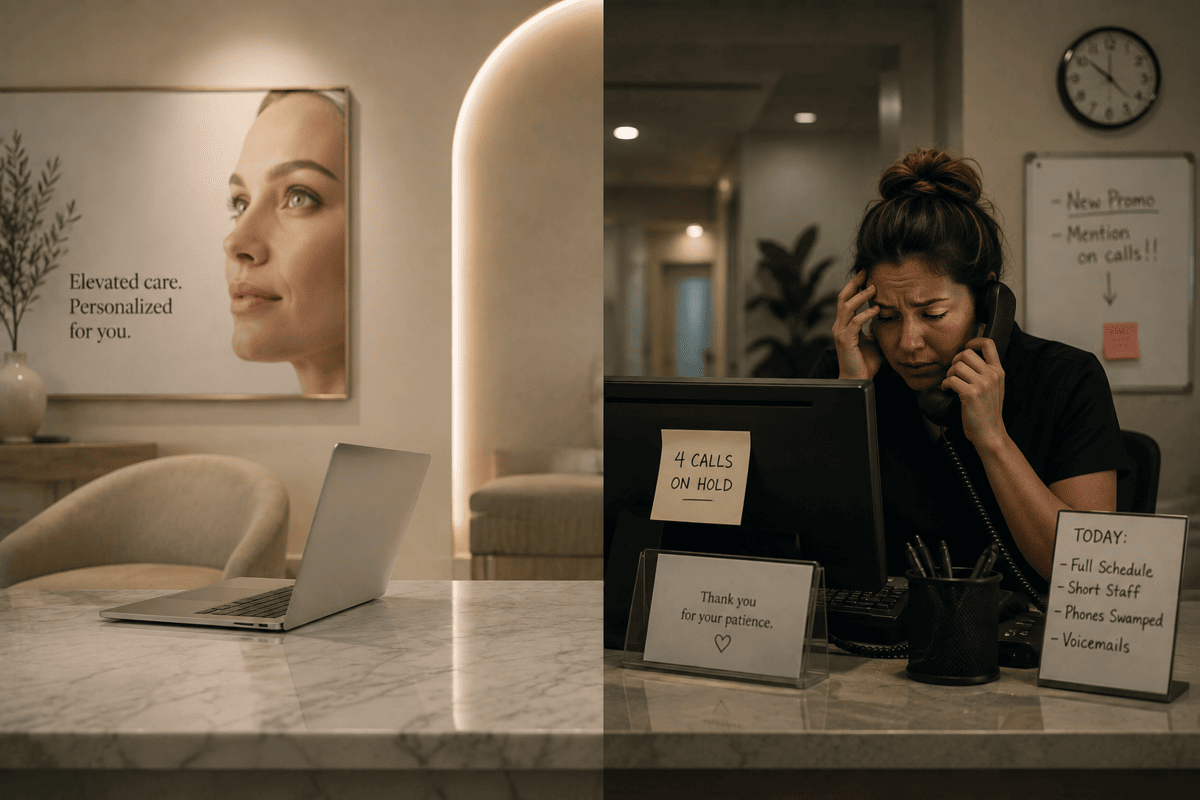
This is also where practices often discover gaps they didn't know existed. The front desk person who is great with in-person patients but curt on the phone. The scheduler who treats every call as a transaction rather than a relationship-building moment. The practice that invested heavily in digital marketing but never trained the person who actually answers the phone to represent the brand the website built.
The first phone call is not a scheduling transaction. It is the culmination of every touchpoint that came before it. Treat it accordingly.
Your Practice Doesn't Have a Marketing Problem. It Has a Trust Problem.
When your online presence and in-person experience tell two different stories.
The patient who asks about price isn't objecting to cost. They're trying to figure out if this practice is in their consideration set at all.
6 min read
8 min read