
Your Practice Doesn't Have a Marketing Problem. It Has a
Most practices think their growth problem is visibility. Get more eyes on the practice, book more consults, revenue follows. Run more ads, post more content, chase more leads. I don't buy it. Not for practices doing real volume.
The Trust Problem
If you're a med spa or surgical practice doing $2M+ a year, you're not invisible. Patients are finding you. They're landing on your site, scrolling your Instagram, reading your reviews. The traffic is there.
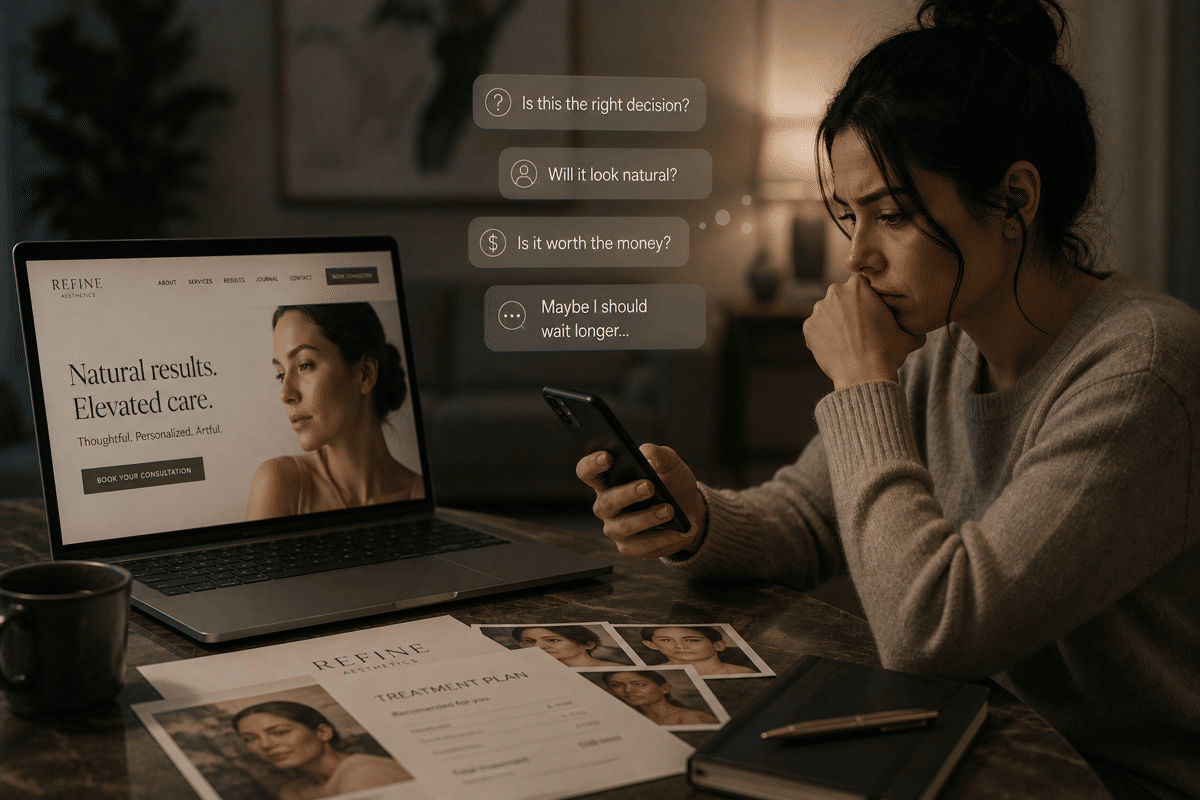
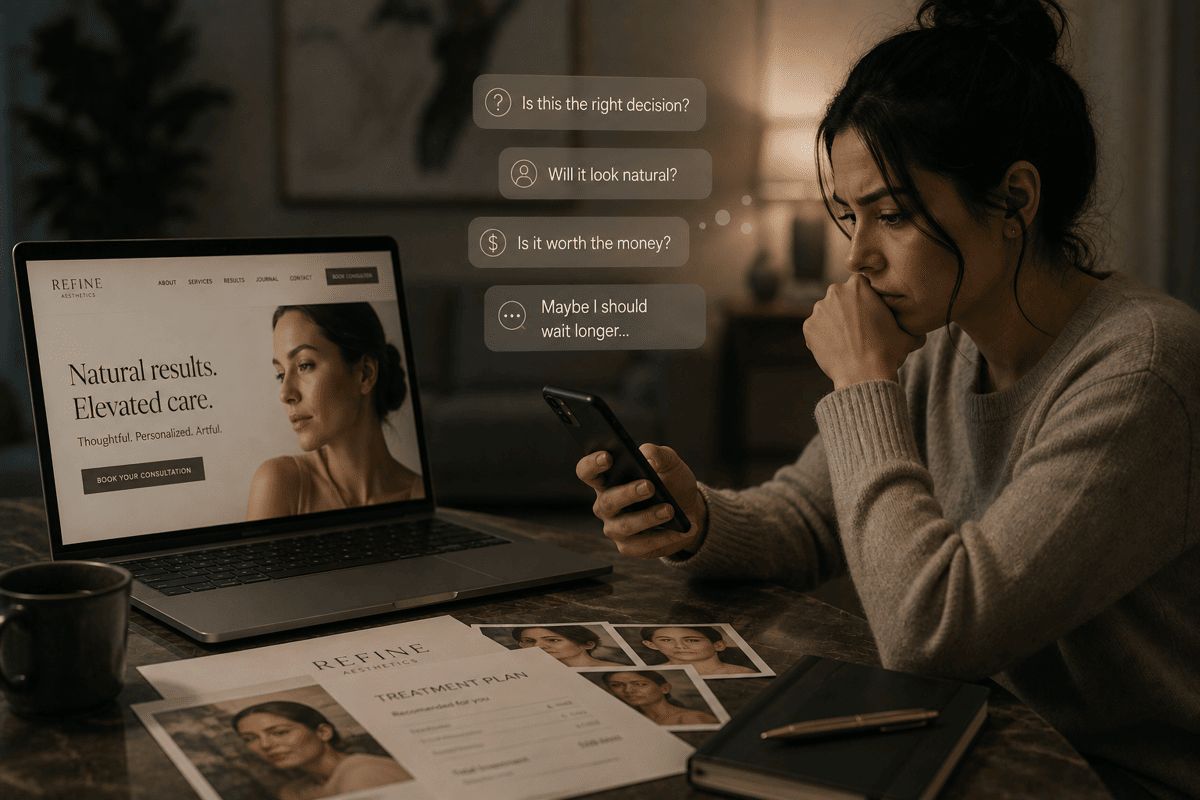
What's breaking down is what happens in their head between "I found this practice" and "I trust this practice enough to book."
That's not a marketing problem. That's a trust problem. And it's usually invisible to the people running the practice, because you're too close to it.
You spend every day inside your practice. You know the outcomes, you know the team, you know exactly what a patient gets when they walk through the door. That knowledge is actually working against you when it comes to understanding how a stranger sees you online, because you can't unsee what you already know.
You look at your own website and your brain fills in fifteen years of context a first-time visitor doesn't have. You're not able to see the gap, because to you there isn't one.
How It Affects Your Practice
Ten years ago, a patient picked a provider based on who was close by and who their friend recommended. That still matters, but it's no longer the whole story. Now a patient can pull up six practices in your city in the time it takes to finish a coffee, compare before-and-afters side by side, and read reviews from patients they've never met before they've made up their mind about who to trust.
The average window to establish digital credibility before a user exits your site.
In that thirty-second window, patients are making decisions about your competence, your care, and your credibility. They're not reading your credentials page. They're looking at the quality of your photos, the tone of your reviews, the professionalism of your website design, and whether your online presence feels consistent with the premium experience you claim to deliver.
Patients are not comparing you to other practices in your city. They're comparing you to every premium experience they've had online.
Every inconsistency between your marketing and your actual patient experience erodes trust. A beautiful website that leads to a chaotic booking process. Stunning before-and-afters paired with unprofessional follow-up communication. These gaps create cognitive dissonance that patients feel even if they can't articulate it.

The Solution
We look at four things when we evaluate a practice's trust architecture:
How you are perceived.
What does a stranger believe about your practice after sixty seconds on your website?
The actual patient experience.
What really happens when someone books, arrives, and completes treatment?
The gaps.
Where do marketing, operations, and patient experience diverge?
A prioritized plan.
Which gaps cost you the most trust, and which are easiest to close?
If your practice is doing the volume, the skill is already there. What's usually costing you patients isn't your outcomes — it's the distance between the experience you're actually capable of delivering and the experience a stranger believes you'll deliver, based on sixty seconds on your website.
Perception is not a vanity metric. It is a business asset that either compounds or erodes with every patient interaction.
What You Can Do Today
Start by seeing your practice the way a first-time visitor sees it. Open an incognito browser window, search for your practice, and go through the entire journey from discovery to booking. Take notes on every moment of friction, every inconsistency, every place where your online presence doesn't match the experience you deliver in person.
Ask your team to do the same exercise independently. Compare notes. The gaps that are invisible to you will be obvious to someone experiencing your practice for the first time.
Then prioritize. You don't need to fix everything at once. Start with the highest-trust, lowest-effort wins: consistent messaging across platforms, a booking process that feels as premium as your treatments, and follow-up communication that reinforces the quality patients experienced in your office.
Trust is built in increments and lost in moments. Every touchpoint is either a deposit or a withdrawal. The practices that win are the ones that understand this and design every interaction accordingly.